

How to Reduce Time to Hire: 10 Proven Strategies for Faster Recruiting
How to Reduce Time to Hire: 10 Proven Strategies for Faster Recruiting
Your best candidates are off the market in 10 days. Meanwhile, the average company takes 44 days to make a hire. That gap is costing you top talent.
Time to hire has increased every year for the past four years, reaching an all-time high in 2025. While some roles fill in two weeks, others remain vacant for months. The difference often comes down to process, not the talent pool.
In this guide, you will learn why time to hire matters, what slows it down, and ten actionable strategies to speed up your recruiting without sacrificing quality.
What is Time to Hire and Why Does It Matter?
Time to hire measures the number of days between when a candidate enters your pipeline and when they accept an offer. It differs from time to fill, which measures from job posting to accepted offer.
Why it matters:
57% of candidates lose interest if the hiring process takes too long, according to Robert Half
Top performers receive competing offers within 10 days
Each additional week of vacancy costs companies an average of $4,000 per role
83% of hiring managers reported missing out on good candidates due to slow processes in 2023
Beyond losing candidates, a long time to hire signals inefficiency to your team and increases workload on existing employees covering vacant roles.
Current Time to Hire Benchmarks by Industry
Understanding where you stand helps set realistic goals. Here are the 2025 averages:
Industry | Average Time to Hire |
|---|---|
Energy & Defense | 67+ days |
Professional Services | 47 days |
Technology | 52 days |
Healthcare | 49 days |
Finance & Banking | 21 to 60 days |
Retail & Consumer | 14 to 21 days |
Tech & Media (fast movers) | 20 days |
The global median sits at 38 days, while the average time to fill is 42 days. If you are above these numbers, there is significant room for improvement.
10 Strategies to Reduce Your Time to Hire
1. Audit Your Current Process
Before optimizing, understand where time actually goes. Break down your hiring process into stages and measure each one:
Job requisition approval
Job posting duration
Sourcing and screening
Interview scheduling
Interview rounds
Decision making
Offer negotiation
Background checks
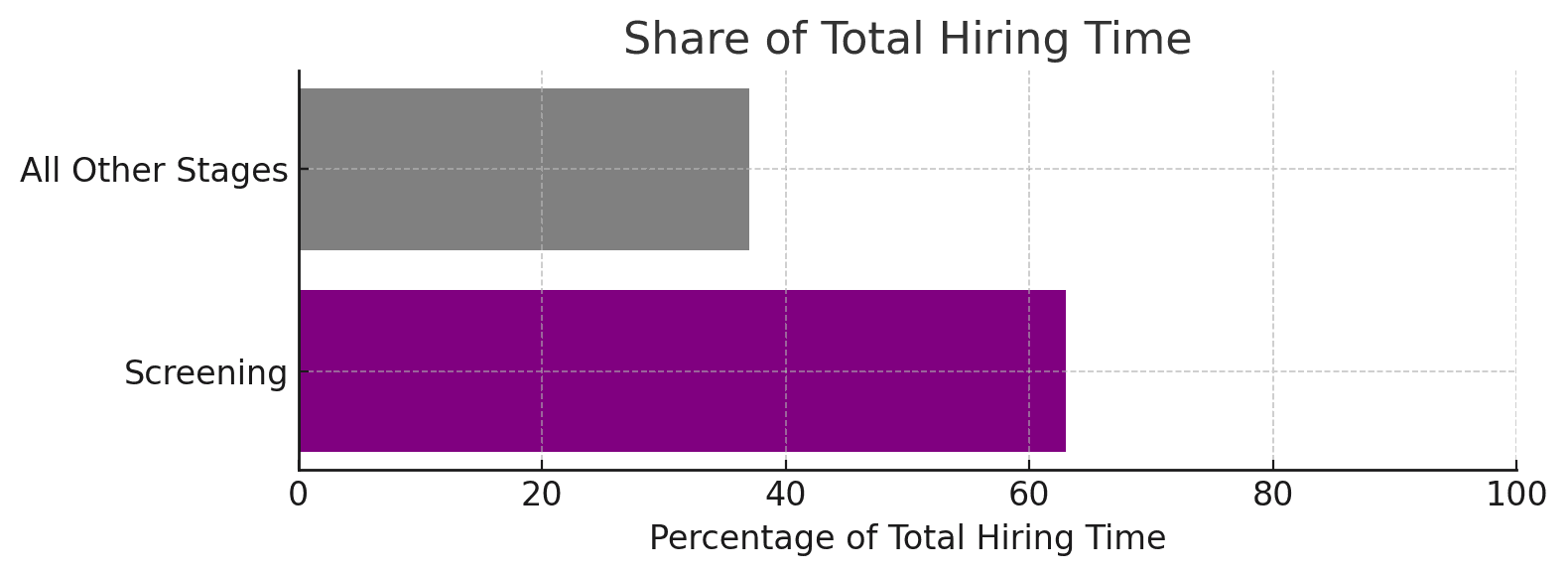
According to People Hum, screening alone consumes 63% of total hiring time. Identify your biggest bottleneck and address it first.
Action step: Track each stage for your last five hires. You will likely find one or two stages where candidates stall.
2. Build a Proactive Talent Pipeline
Reactive hiring, where you only start sourcing when a role opens, is the primary cause of extended timelines. Companies with pre-built talent pools can cut days or weeks from their process.
How to build one:
Keep silver-medal candidates from previous searches warm
Engage passive candidates before you need them
Use a candidate database to organize prospects by skills and roles
Nurture relationships through periodic updates about your company
With HrPanda, you can transfer promising candidates to your talent pool with one click, keeping them organized for future opportunities without cluttering your active pipeline.
3. Use AI for Initial Screening
Manual resume screening is time-intensive and prone to inconsistency. AI-powered screening tools can evaluate hundreds of applications in minutes while applying uniform criteria.
According to SHRM, 43% of organizations now use AI in HR tasks, up from 26% in 2024. The benefits include:
30 to 50% faster time to hire
Consistent evaluation across all candidates
Reduced bias when properly configured
Freed recruiter time for high-value activities
HrPanda's AI Fit Algorithm analyzes and scores candidates automatically, surfacing the best matches so recruiters can focus on engaging rather than filtering.
4. Streamline Interview Scheduling
Interview coordination is a hidden time sink. Each round of back-and-forth emails to find a mutually available time adds days to your process.
Solutions that work:
Use scheduling tools that sync with interviewer calendars
Offer candidates multiple time slots upfront
Set weekly interview blocks to reduce coordination
Run panel interviews instead of sequential rounds when possible
Modern applicant tracking systems include interview scheduling features that let candidates self-schedule based on real-time availability.
5. Standardize Your Interview Process
Unstructured interviews lead to longer decision times because interviewers assess different things and struggle to compare candidates. A standardized process fixes this.
Create structured interviews with:
Defined competencies for each role
Consistent questions across all candidates
Scoring rubrics for objective evaluation
Clear decision criteria before interviews begin
According to Paylocity's 2025 report, the interview stage alone lasts 8 to 10 days in most organizations. Structured processes help teams reach consensus faster.
6. Reduce Interview Rounds
Companies now conduct 42% more interviews per hire than in 2021, averaging 20 interviews per hire compared to 14 previously. More rounds do not always mean better outcomes.
Evaluate whether you need:
Multiple technical screens, or one comprehensive assessment
Separate culture fit interviews, or integrated evaluation
Executive sign-off rounds that add days without changing decisions
Consider tiered processes: entry-level roles might need two rounds, while senior positions warrant more. Not every hire requires the same rigor.
7. Enable Faster Candidate Communication
Candidates evaluate you during the hiring process. Slow responses signal disorganization and make them question whether they want to work for you.
Speed up communication by:
Setting response time SLAs (for example, 24 hours for initial contact)
Using email templates for common touchpoints
Enabling candidates to respond without creating accounts
Providing real-time status updates
HrPanda's engagement messaging lets you send templated communications while candidates reply via email without any registration, keeping momentum high.
8. Run Background Checks in Parallel
Many companies wait until the final stage to initiate background checks, adding 5 to 10 days after an offer is extended. This sequential approach delays start dates unnecessarily.
Better approaches:
Begin reference checks during final interview rounds
Run background checks concurrently with offer negotiations
Partner with providers who offer expedited processing
Be transparent with candidates about the timeline
This parallel processing can recover a full week in your timeline without cutting corners.
9. Empower Hiring Managers to Decide
Slow decision-making after interviews is a common bottleneck. When hiring managers wait for additional approvals or postpone decisions, candidates move on.
Improve decision speed by:
Scheduling debrief meetings immediately after final interviews
Setting decision deadlines (for example, 48 hours post-interview)
Giving hiring managers authority to make offers within approved bands
Using recruitment analytics to identify decision bottlenecks
Uber's data team analyzed their recruitment funnel, identified drop-off points, and reduced overall time to hire by 35% through process refinements like these.
10. Measure and Iterate Continuously
Time to hire is not a one-time fix. Market conditions change, internal processes drift, and new bottlenecks emerge. Regular measurement keeps you on track.
Track these talent acquisition metrics:
Time to hire by role, department, and recruiter
Stage-to-stage conversion times
Candidate drop-off rates
Offer acceptance rates
Source effectiveness
When you see numbers trending upward, investigate immediately. Small delays compound across dozens of hires per year.
Common Mistakes That Slow Down Hiring
Avoid these pitfalls:
Writing overly specific job descriptions: Requiring rare skill combinations extends your search. Focus on must-haves versus nice-to-haves.
Waiting for the perfect candidate: The perfect candidate may not exist, or may not be looking. Strong candidates who can grow often outperform unicorn searches.
Involving too many stakeholders: Each additional interviewer adds scheduling complexity. Be deliberate about who needs to evaluate each role.
Neglecting candidate experience: A confusing application process or poor communication causes drop-offs. Your candidate experience affects conversion at every stage.
Using outdated tools: Spreadsheets and email chains cannot scale. Modern recruitment software automates the manual work that slows you down.
How HrPanda Helps You Hire Faster
HrPanda was built to eliminate the friction in modern hiring. Here is how it addresses the strategies above:
AI-powered screening: The AI Fit Algorithm evaluates candidates instantly, replacing hours of manual resume review with intelligent scoring.
Talent pool management: Move promising candidates to your talent pool in one click. When new roles open, you already have qualified prospects ready.
Streamlined communication: Email templates and candidate responses without registration keep conversations moving without administrative overhead.
Modern interface: Unlike legacy ATS platforms from the 90s, HrPanda's intuitive design means faster adoption and less time lost to training.
Pipeline visibility: Multiple views, including Sheet, Pipeline, and List, let you see exactly where every candidate stands and identify bottlenecks at a glance.
Companies like HubX scaled their hiring with HrPanda, praising the clean Kanban views and powerful filtering that replaced their previous slower system.
Start Reducing Your Time to Hire Today
Every day you take to hire is a day your competitors might close the candidate you want. The ten strategies above provide a roadmap, but implementation requires the right tools and mindset.
Start with measurement: know your current time to hire by stage. Identify the biggest bottleneck. Address it with process changes or technology. Then measure again.
Incremental improvements compound. Cutting two days from scheduling and three days from decision-making adds up to weeks saved across your annual hiring volume.
Ready to modernize your hiring process? See how HrPanda's AI-powered ATS can help you find better candidates in less time.
FAQ
What is a good time to hire?
A good time to hire depends on your industry and role complexity. Most industries aim for 14 to 30 days. The global median is 38 days. If you are above 40 days consistently, there is room for improvement.
How do I calculate time to hire?
Time to hire equals the date the candidate accepted the offer minus the date they entered your pipeline (typically when they applied or were sourced). Track this in your ATS for accurate measurement.
What is the difference between time to hire and time to fill?
Time to fill measures from job requisition approval or posting to offer acceptance. Time to hire measures from candidate entry to offer acceptance. Time to fill includes the sourcing period; time to hire focuses on process efficiency once candidates are in your funnel.
Can reducing time to hire hurt quality of hire?
Not when done correctly. The goal is eliminating waste, not cutting corners. Faster screening, parallel processes, and quicker decisions do not mean lower standards. Monitor quality of hire alongside time to hire to ensure both metrics improve.
Which stage of hiring takes the longest?
Screening typically consumes 63% of hiring time, according to People Hum. Interview scheduling and decision-making are also common bottlenecks. Audit your own process to find your specific delays.
Statistics Sources:
44 days average time to hire: AMS and Josh Bersin Co. (2025)
57% candidates lose interest: Robert Half survey
Top candidates off market in 10 days: LinkedIn Global Talent Trends
63% of hiring time in screening: People Hum
43% organizations use AI in HR: SHRM 2025 survey
42% more interviews per hire since 2021: GoodTime 2025 Hiring Insights Report
35% time to hire reduction at Uber: Industry case study
83% of hiring managers missed good candidates: Robert Half 2023 survey
Your best candidates are off the market in 10 days. Meanwhile, the average company takes 44 days to make a hire. That gap is costing you top talent.
Time to hire has increased every year for the past four years, reaching an all-time high in 2025. While some roles fill in two weeks, others remain vacant for months. The difference often comes down to process, not the talent pool.
In this guide, you will learn why time to hire matters, what slows it down, and ten actionable strategies to speed up your recruiting without sacrificing quality.
What is Time to Hire and Why Does It Matter?
Time to hire measures the number of days between when a candidate enters your pipeline and when they accept an offer. It differs from time to fill, which measures from job posting to accepted offer.
Why it matters:
57% of candidates lose interest if the hiring process takes too long, according to Robert Half
Top performers receive competing offers within 10 days
Each additional week of vacancy costs companies an average of $4,000 per role
83% of hiring managers reported missing out on good candidates due to slow processes in 2023
Beyond losing candidates, a long time to hire signals inefficiency to your team and increases workload on existing employees covering vacant roles.
Current Time to Hire Benchmarks by Industry
Understanding where you stand helps set realistic goals. Here are the 2025 averages:
Industry | Average Time to Hire |
|---|---|
Energy & Defense | 67+ days |
Professional Services | 47 days |
Technology | 52 days |
Healthcare | 49 days |
Finance & Banking | 21 to 60 days |
Retail & Consumer | 14 to 21 days |
Tech & Media (fast movers) | 20 days |
The global median sits at 38 days, while the average time to fill is 42 days. If you are above these numbers, there is significant room for improvement.
10 Strategies to Reduce Your Time to Hire
1. Audit Your Current Process
Before optimizing, understand where time actually goes. Break down your hiring process into stages and measure each one:
Job requisition approval
Job posting duration
Sourcing and screening
Interview scheduling
Interview rounds
Decision making
Offer negotiation
Background checks
According to People Hum, screening alone consumes 63% of total hiring time. Identify your biggest bottleneck and address it first.
Action step: Track each stage for your last five hires. You will likely find one or two stages where candidates stall.
2. Build a Proactive Talent Pipeline
Reactive hiring, where you only start sourcing when a role opens, is the primary cause of extended timelines. Companies with pre-built talent pools can cut days or weeks from their process.
How to build one:
Keep silver-medal candidates from previous searches warm
Engage passive candidates before you need them
Use a candidate database to organize prospects by skills and roles
Nurture relationships through periodic updates about your company
With HrPanda, you can transfer promising candidates to your talent pool with one click, keeping them organized for future opportunities without cluttering your active pipeline.
3. Use AI for Initial Screening
Manual resume screening is time-intensive and prone to inconsistency. AI-powered screening tools can evaluate hundreds of applications in minutes while applying uniform criteria.
According to SHRM, 43% of organizations now use AI in HR tasks, up from 26% in 2024. The benefits include:
30 to 50% faster time to hire
Consistent evaluation across all candidates
Reduced bias when properly configured
Freed recruiter time for high-value activities
HrPanda's AI Fit Algorithm analyzes and scores candidates automatically, surfacing the best matches so recruiters can focus on engaging rather than filtering.
4. Streamline Interview Scheduling
Interview coordination is a hidden time sink. Each round of back-and-forth emails to find a mutually available time adds days to your process.
Solutions that work:
Use scheduling tools that sync with interviewer calendars
Offer candidates multiple time slots upfront
Set weekly interview blocks to reduce coordination
Run panel interviews instead of sequential rounds when possible
Modern applicant tracking systems include interview scheduling features that let candidates self-schedule based on real-time availability.
5. Standardize Your Interview Process
Unstructured interviews lead to longer decision times because interviewers assess different things and struggle to compare candidates. A standardized process fixes this.
Create structured interviews with:
Defined competencies for each role
Consistent questions across all candidates
Scoring rubrics for objective evaluation
Clear decision criteria before interviews begin
According to Paylocity's 2025 report, the interview stage alone lasts 8 to 10 days in most organizations. Structured processes help teams reach consensus faster.
6. Reduce Interview Rounds
Companies now conduct 42% more interviews per hire than in 2021, averaging 20 interviews per hire compared to 14 previously. More rounds do not always mean better outcomes.
Evaluate whether you need:
Multiple technical screens, or one comprehensive assessment
Separate culture fit interviews, or integrated evaluation
Executive sign-off rounds that add days without changing decisions
Consider tiered processes: entry-level roles might need two rounds, while senior positions warrant more. Not every hire requires the same rigor.
7. Enable Faster Candidate Communication
Candidates evaluate you during the hiring process. Slow responses signal disorganization and make them question whether they want to work for you.
Speed up communication by:
Setting response time SLAs (for example, 24 hours for initial contact)
Using email templates for common touchpoints
Enabling candidates to respond without creating accounts
Providing real-time status updates
HrPanda's engagement messaging lets you send templated communications while candidates reply via email without any registration, keeping momentum high.
8. Run Background Checks in Parallel
Many companies wait until the final stage to initiate background checks, adding 5 to 10 days after an offer is extended. This sequential approach delays start dates unnecessarily.
Better approaches:
Begin reference checks during final interview rounds
Run background checks concurrently with offer negotiations
Partner with providers who offer expedited processing
Be transparent with candidates about the timeline
This parallel processing can recover a full week in your timeline without cutting corners.
9. Empower Hiring Managers to Decide
Slow decision-making after interviews is a common bottleneck. When hiring managers wait for additional approvals or postpone decisions, candidates move on.
Improve decision speed by:
Scheduling debrief meetings immediately after final interviews
Setting decision deadlines (for example, 48 hours post-interview)
Giving hiring managers authority to make offers within approved bands
Using recruitment analytics to identify decision bottlenecks
Uber's data team analyzed their recruitment funnel, identified drop-off points, and reduced overall time to hire by 35% through process refinements like these.
10. Measure and Iterate Continuously
Time to hire is not a one-time fix. Market conditions change, internal processes drift, and new bottlenecks emerge. Regular measurement keeps you on track.
Track these talent acquisition metrics:
Time to hire by role, department, and recruiter
Stage-to-stage conversion times
Candidate drop-off rates
Offer acceptance rates
Source effectiveness
When you see numbers trending upward, investigate immediately. Small delays compound across dozens of hires per year.
Common Mistakes That Slow Down Hiring
Avoid these pitfalls:
Writing overly specific job descriptions: Requiring rare skill combinations extends your search. Focus on must-haves versus nice-to-haves.
Waiting for the perfect candidate: The perfect candidate may not exist, or may not be looking. Strong candidates who can grow often outperform unicorn searches.
Involving too many stakeholders: Each additional interviewer adds scheduling complexity. Be deliberate about who needs to evaluate each role.
Neglecting candidate experience: A confusing application process or poor communication causes drop-offs. Your candidate experience affects conversion at every stage.
Using outdated tools: Spreadsheets and email chains cannot scale. Modern recruitment software automates the manual work that slows you down.
How HrPanda Helps You Hire Faster
HrPanda was built to eliminate the friction in modern hiring. Here is how it addresses the strategies above:
AI-powered screening: The AI Fit Algorithm evaluates candidates instantly, replacing hours of manual resume review with intelligent scoring.
Talent pool management: Move promising candidates to your talent pool in one click. When new roles open, you already have qualified prospects ready.
Streamlined communication: Email templates and candidate responses without registration keep conversations moving without administrative overhead.
Modern interface: Unlike legacy ATS platforms from the 90s, HrPanda's intuitive design means faster adoption and less time lost to training.
Pipeline visibility: Multiple views, including Sheet, Pipeline, and List, let you see exactly where every candidate stands and identify bottlenecks at a glance.
Companies like HubX scaled their hiring with HrPanda, praising the clean Kanban views and powerful filtering that replaced their previous slower system.
Start Reducing Your Time to Hire Today
Every day you take to hire is a day your competitors might close the candidate you want. The ten strategies above provide a roadmap, but implementation requires the right tools and mindset.
Start with measurement: know your current time to hire by stage. Identify the biggest bottleneck. Address it with process changes or technology. Then measure again.
Incremental improvements compound. Cutting two days from scheduling and three days from decision-making adds up to weeks saved across your annual hiring volume.
Ready to modernize your hiring process? See how HrPanda's AI-powered ATS can help you find better candidates in less time.
FAQ
What is a good time to hire?
A good time to hire depends on your industry and role complexity. Most industries aim for 14 to 30 days. The global median is 38 days. If you are above 40 days consistently, there is room for improvement.
How do I calculate time to hire?
Time to hire equals the date the candidate accepted the offer minus the date they entered your pipeline (typically when they applied or were sourced). Track this in your ATS for accurate measurement.
What is the difference between time to hire and time to fill?
Time to fill measures from job requisition approval or posting to offer acceptance. Time to hire measures from candidate entry to offer acceptance. Time to fill includes the sourcing period; time to hire focuses on process efficiency once candidates are in your funnel.
Can reducing time to hire hurt quality of hire?
Not when done correctly. The goal is eliminating waste, not cutting corners. Faster screening, parallel processes, and quicker decisions do not mean lower standards. Monitor quality of hire alongside time to hire to ensure both metrics improve.
Which stage of hiring takes the longest?
Screening typically consumes 63% of hiring time, according to People Hum. Interview scheduling and decision-making are also common bottlenecks. Audit your own process to find your specific delays.
Statistics Sources:
44 days average time to hire: AMS and Josh Bersin Co. (2025)
57% candidates lose interest: Robert Half survey
Top candidates off market in 10 days: LinkedIn Global Talent Trends
63% of hiring time in screening: People Hum
43% organizations use AI in HR: SHRM 2025 survey
42% more interviews per hire since 2021: GoodTime 2025 Hiring Insights Report
35% time to hire reduction at Uber: Industry case study
83% of hiring managers missed good candidates: Robert Half 2023 survey
Explore More Insights


Take your recruitment strategies to the next level with

Collaboration
Integrations
Templates
Career Page
Panda is reimagining how next-gen companies do recruitment. Join us on the journey to transform HR into a next-generation powerhouse.
© 2026 HrPanda
Take your recruitment strategies to the next level with
Collaboration
Integrations
Templates
Career Page
Panda is reimagining how next-gen companies do recruitment. Join us on the journey to transform HR into a next-generation powerhouse.
© 2026 HrPanda
Take your recruitment strategies to the next level with
Collaboration
Integrations
Templates
Career Page
Panda is reimagining how next-gen companies do recruitment. Join us on the journey to transform HR into a next-generation powerhouse.
© 2026 HrPanda